Showing posts with label NCAA Baseball. Show all posts

June 14, 2013

LSU Assistant Returning to Omaha After 30 Years

By - Keith Smith

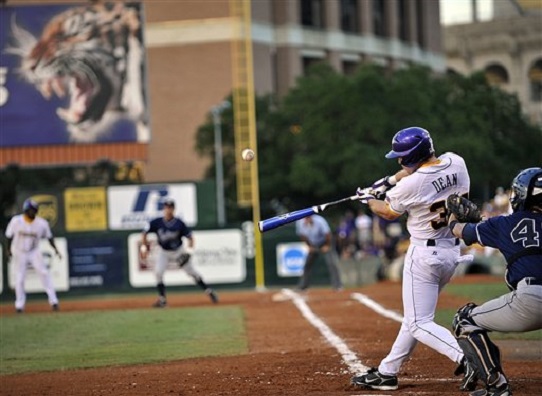
LSU pitching coach Alan Dunn is returning to the College World Series this weekend after a 30-year absence, hoping for one more win than the last time he was there.

Photo by: Catherine Threlkeld
Dunn was part of the '83 Alabama team that lost by one run in the finals to the Texas Longhorns, led by future major-leaguers Roger Clemens and Calvin Schiraldi. Along the way, the tide defeated Arizona State twice, with Barry Bonds and Oddibe McDowell, and the University of Michigan, who boasted the likes of Barry Larkin, Hal Morris, Chris Sabo and Scott Kamieniecki.

The Tide and Longhorns were the only undefeated clubs when Texas won 6-4 in 10 innings in the winners bracket final (the format was different in 1983). Then they fought their way back to the finals, only to drop a 4-3 heartbreaker in the championship.

It would be an overstatement to say Dunn has obsessed about it for the past 30 years. It would also probably be an understatement to say he hasn't thought about it at all.

To be fair, this is only Dunn's third season as a collegiate coach, two at LSU and one at Vanderbilt, so it would have been difficult for him to have made it back. The rest of his coaching career was spent in the minor and major leagues, first with the Cubs and then the Orioles organizations, following a brief career as a minor league player. That career was cut short far too soon by elbow and shoulder problems.

Dunn reported to Alabama as a highly touted freshman in 1981, as both a third baseman and pitcher. He was competing at the positions with future major leaguer David Magadan. They roomed together as freshmen, with Magadan excelling as a strong contact hitter and Dunn as a barrel-chested power hitter. I saw balls come off his bat that looked like they were shot out of a cannon.
March 9, 2013

A Walk in the Cleats of a College Baseball Player: Regular Season Routine

By - Jaquan Murphy

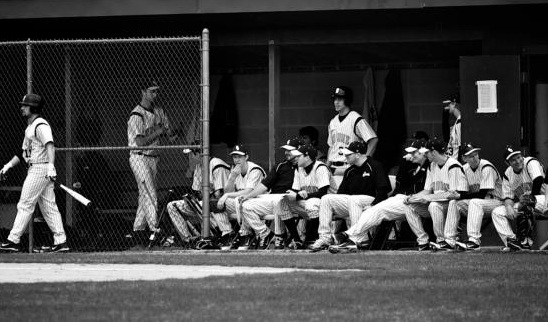
As spring comes in, so does the regular season. The spring semester brings a hectic seven day a week schedule. Starting in early March, a college baseball player spends every weekend playing a three-game series consisting of one game on Friday, Saturday and Sunday.

Photo by: Adam Myers
In addition to the weekend series, there is usually a game on either Tuesday or Wednesday of each week as well. A college player participates in around 60 games during a single school year. This is substantially more than the majority of other college sports. In addition, half of the games are away games and require a significant amount of travel time.

A typical Friday consists of meeting at the team bus at around 6 in the morning to travel to the game. Breakfast is supplied on the bus, and many players either sleep or do homework during the course of the trip.

After a quick stop for lunch, you head straight to the field for pregame preparation and the game itself. After the game, the team checks into a hotel and has a team dinner followed by a team meeting to discuss the schedule for the following day. Lights out is at or around 11 p.m. for most teams.

The demanding schedule is familiar to all college student-athletes. It takes excellent time management skills and strong motivation to meet the requirements of both school and sport.

March 2, 2013

A Walk in the Cleats of a College Baseball Player: Preseason Preparation

By - Jaquan Murphy

Six in the morning. The weather is cold. The sun is rising. Most college students are in bed sleeping or just waking up. All except a select group. College baseball players find themselves in a gym or on a field, tirelessly working on preseason conditioning drills.

Photo by: Eric Beavan
The preseason of college baseball is both the most mentally and physically demanding time for a player. Generally coinciding with the start of the school year, a player is forced to juggle the adjustment to a new class schedule, new teachers and new classmates. They have to get accustomed to the personalities of their peers as well as the professors that will instruct them for the next five months. Stack that with having to learn all the new work in their classes, and it is enough to drive someone crazy.

But all college students go through that, right? So what makes players different?

The physical changes that a player endures makes the mental adjustments seem a lot harder. Waking up earlier, increasing physical demands on the body and getting accustomed to new teammates, coaches and concepts all stare a player in the face. Not only that, but some players have to deal with the fact that they are also competing for a starting job on the diamond.

More intimately on the field, players tend to spend the preseason using the time to get the body revved up to start the regular season. A lot of stretching is done during this period to make sure that all the muscles are loosened up so the player does not get injured.

Plenty of drills are run during this time as well. Seemingly endless workouts that are designed to help strengthen little things that affect hitting, fielding, pitching and base running. This is the time when the most coaching is done. Constant adjustments are suggested and implemented for players to improve all aspects of their game.

For most, one of the most exciting parts of the preseason is receiving new gear. Breaking in new cleats, taking some hacks with the new sticks and shagging some flies with some fresh leather is often the high point for a lot of guys during this period. For others, usually for the younger players, this time is exciting because it is when players are issued their jersey numbers and uniforms.

February 23, 2013

A Walk in the Cleats of a College Baseball Player: Life as a Collegiate Athlete

By - Jaquan Murphy

Life as a college athlete is always glorified as an easy lifestyle where everything is done for the athlete and he or she is spoon fed through four (or however long they stay) years of school. There may be a few institutions where that's how it is, but in most cases, that glorified life only exists on television.

For the next several weeks, I will give a firsthand account of the life of a college athlete, and what it's like playing baseball in the unpredictable northeast region of the country.

Photo by: Getty Images
I play for the City College of New York, a four-year Division III school located in New York City. Although we are only a D3 school, our offseasons are just as grueling as a D1's are. We are placed under high expectations to take care of our bodies and rehab any injuries from the prior season or from our brief fall ball season.

In addition, we are expected to follow a rigorous workout plan that embraces strength training, agility and cardio workouts. It is not just expected that we come back in good shape, it is demanded that we come back in better shape. As a team, we workout together in groups as a way to make the workouts more productive by pushing each other to our limits to better ourselves overall.

Along with the workouts, we are expected to make use of our facilities. In other words, use of our batting cages and gymnasium in order for our hitters to work on flaws in anything from their swing to their stance or even their approach, and for our pitchers to do the same with their mechanics. This is also time for our pitchers to master their pitch repertoire and even work on adding new pitches.

This time of the year is great for both hitters and pitchers to learn their craft from players of similar positions and players on the other end of the spectrum. For example, this would be the only time where a pitcher can get direct feedback from a hitter on how his pitch moves, how his delivery is from a hitter's standpoint, and how hard his pitches are really coming in. On the other hand, this is a perfect time for a hitter to get feedback from pitchers on how a pitcher would approach pitching to him based on things like his size, stance, place in the lineup and swing. The pitching-hitting dynamic is a mind game, and the offseason is the best time to gain a competitive edge.

Above all, the primary objective in the offseason is to stay academically eligible. As cliche as it sounds, a player is called a student-athlete for a reason. The 'student' comes before 'athlete' because without the proper grades, there will be no athlete. Generally, the difficulty of an athlete's academic workload will depend on his class year.

June 29, 2011

South Carolina Gamecocks Repeat as College World Series Champions

By - Kris Fletcher

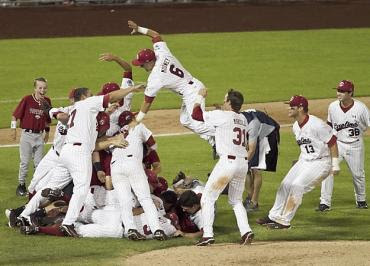
Yesterday the South Carolina Gamecocks won their second straight National Championship with a 5-2 victory that completed a two-game sweep over the Florida Gators in the College World Series final.

Peter Mooney doubled to start a three-run third inning and hit South Carolina's first home run of the CWS in the sixth. Michael Roth pitched 7 and 2/3 innings to pick up the win, and Matt Price closed out the game for his 20th save.

Photo by: Nati Harnik
South Carolina (55-14) becomes the first team to go 10-0 in an NCAA tournament and the first since the Oregon State Beavers in 2007 to go unbeaten in a College World Series.

Their streaks of sixteen NCAA tournament wins and eleven straight in the CWS are both the longest all-time. They also have the distinction of winning the last College World Series at Rosenblatt Stadium and the first at TD Ameritrade Park.

June 14, 2011

Vandy Baseball Makes First Trip to Omaha in School History

By - Brian Harrington

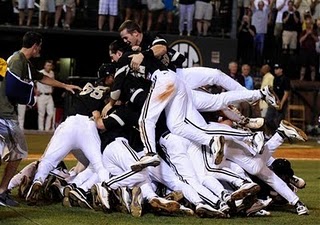
This past weekend, the Vanderbilt Commodores baseball team clinched their first trip to Omaha for the NCAA College World Series with a 9-3 win over a very talented Oregon State Beavers team.

Photo by: Alan Poizner
Vandy has been downright dominant this season, posting a 52-10 record (33-4 at home, 16-5 on the road, 3-1 on neutral sites, and 25-9 in the SEC), but the most astounding statistic is that they've outscored their opponents 441-172. That's just insane.

The team is led by seventh year coach Tim Corbin, who has turned them from the punching bag of the SEC to a title contender. On offense, their led by junior first baseman Aaron Westlake, who has a .353 batting average and 17 home runs. Junior Sonny Gray leds the pitching staff with a 13-3 record and 1.97 earned run average. Gray was a four year starter and letter-man in baseball and also a two year captain and three year letter-man as the quarterback for Smyrna H.S. right here in Tennessee. Another star player on the team is sophomore outfielder Mike Yastrzemski, grandson of Boston Red Sox Hall of Famer Carl Yastrzemski, who was the last man to win the triple crown in Major League Baseball (1964).